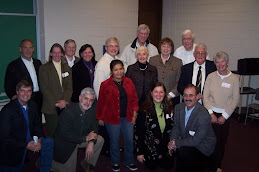
It’s with great sadness that we report that one of WEORC’s founders, Jim
Wilbur (85), entered into eternal life two weeks ago. Jim was living at
Bethlehem Woods in La Grange with his dear wife, Joan (nee Johnson). Jim was a
long-time resident of Evanston.
Jim was ordained in1956 for the
Chicago Archdiocese. Even when he did leave active ministry, his love for the
Liturgy and organization never left him. Eventually he became the editor-in-chief
at JS Paluch Company. He worked with Marty Hegarty in founding WEORC in the
late 1970’s and put together the first WEORC directory. He was a stalwart
presence in helping many transition from clerical and religious life to careers
in the secular world.
His funeral Mass was held on Saturday, February 28, at the Congregation
of the Sisters of St. Joseph Chapel, 1515 W. Ogden Ave., LaGrange Park. Memorials
to Sheil Catholic Center at Northwestern University appreciated.
Talk about a head-scratcher. I wonder if anyone in the Vatican
recognizes the absurdity of all this?
Another case of a priest leaving to get married, being
replaced by a married priest – in this case, a former Anglican priest who with
his wife and family, entered the Catholic Church. There were several cases of
this in England
when the Anglican Church started ordaining women. Full details can be found in
the Tablet article at…
Chicago’s Cardinal George
ordained a dozen priests on May 17th – one of the largest ordination
classes in the US
this year. However, that is a far cry from the 30 to 40 that were ordained
annually a few decades ago. And they can scarcely replace the 31 Chicago priests that died
in 2013. The continued decline of traditional clergy was reiterated in the
recent newspaper article in Florida.
Perhaps a new kind of priesthood is needed.
U.S. Catholics face shortage of priests
Dave
Breitenstein, The (Fort Myers,
Fla.) News-Press7:06 a.m. EDT May 25, 2014
FORT MYERS, Fla. -- Nationally, one in five Catholic
parishes does not have a resident priest.
America's Catholic population
is rising by 1 percent annually, but seminary enrollment is flat. An inadequate
supply of priests already has forced hundreds of parishes to close or
consolidate.
Priests aren't getting any younger, either. Their average age is
63.
Something's got to give.
"These people have served the church for 30, 40 or 50
years, and now they are retiring or dying and leaving the priesthood,"
said Mary Gautier, senior research associate with GeorgetownUniversity's
Center for Applied Research in the Apostolate.
In the Diocese of Venice, Fla., though, Bishop Frank Dewane is
sitting comfortably for the 59 parishes from Bradenton
to MarcoIsland. Dewane has 111 diocesan priests
under his authority, along with 60 priests supplied by religious orders.
Additionally, between 10 and 70 outside priests, who often are retirees from
parishes up North, assist the diocese on a seasonal or part-time basis.
Dewane's focus isn't covering next Sunday's Mass; he is charged
with building the next generation of religious leaders.
"We're blessed right now, but we always have to look at
where are we in, say, 25 years or 50 years out," Dewane said.
In 1975, there were 58,909 priests in the United States.
Today, Georgetown's
CARA puts the figure at 39,600, a 33 percent drop. Meanwhile, America's Catholic
population rose from 54.5 million to 78.2 million, a 43 percent increase,
during the same period.
Although the 39,600 priests seems plenty for America's
17,413 parishes, it's not. Presiding over Mass is just one of a priest's
duties, along with hearing confessions, baptizing babies, officiating weddings,
counseling parishioners, conducting funerals, teaching schoolchildren, blessing
hospital patients, running missions and more. On Easter and Christmas, some
parishes in Southwest Florida have a half-dozen
or more Masses, often simultaneously on church campuses, to accommodate
residents, tourists and seasonal residents.
"I don't know of any bishop who believes he has too many
priests," said the Rev. John Guthrie, associate director for the
secretariat of clergy, consecrated life and vocations with the U.S. Conference
of Catholic Bishops.
Nationally, Guthrie said, the ratio of priests to parishioners
in 1950 was 1 to 652, but that climbed to 1 to 1,653 by 2010. That doesn't
account for the millions of Catholics who are not registered with a parish or
regularly attend services.
"There are fewer of us doing more and more work,"
Guthrie said.
When schoolteachers are sick or on vacation, a principal finds
substitute teachers. The same holds true for a church when priests are needed.
A long-term vacancy at school, however, poses more serious
problems: Who will teach students, and will their education suffer because of
instability and inconsistency? The same questions arise for a parish without a
resident priest: Who will provide spiritual guidance and manage the parish? In
some cases, the answer is no one.
"There are places where they only hold Mass once a month
because that's the only time you can get a priest," Gautier said.
The recent sex abuse scandals certainly had an impact on the
priesthood, damaging the reputation of priests and possibly keeping some men
from considering the priesthood.
"Did the scandals hurt? Yes they did," said the Rev.
Cory Mayer, vocations director for the Diocese of Venice and parish
administrator at Ave Maria. "There were victims, and justice needs to be
served. But the good young men see the scandal wasn't part of the church or its
teachings."
The Rev. Rafal Ligenza, parochial vicar at St. William Parish in
Naples, was raised in Poland, the homeland of Pope John
Paul II. Consequently, priests are among the most-respected professions for
Polish boys deciding what to do with their lives.
"Here, it's being a doctor," said Ligenza, 32.
"There, it was being a priest."
Mayer counsels youth and adults who are contemplating possible
roles within the church. The first and most important trait he seeks is a deep
love for God. Beyond that, a potential priest must be willing to give himself
to Christ, realize he will forever serve the church and be humble.
"The worst thing we can have is an arrogant priest,"
Mayer said.
Beyond established religions with large, permanent church
buildings are a growing number of unofficial or unsanctioned religious
gatherings in parks, strip malls, beaches and schools.
Deborah Rose-Milavec, executive director of Ohio-based
FutureChurch, said people still want to pray and religious leaders still want
to lead a congregation, but the Vatican
has steadfastly remained traditional and expressed no interest in allowing
married or female priests.
"Church is happening, and it will continue to happen,"
Rose-Milavec said. "The big question is how will the official church
respond."
FutureChurch's position is that the Vatican should consider married men
and all women for leadership positions, including ordination.
"They could be brought into roles where they aren't just
making coffee, but making decisions," Rose-Milavec said of women.
Pope Francis is at least willing to listen. In October, an advisory
board of bishops will gather in Rome
for a summit titled "The Pastoral Challenges of the Family in the Context
of Evangelization." There, Catholic leaders could discuss the issues of
marriage and women's roles within the Church, although change is not considered
imminent.
Fort Myers resident Gerry Mater,
74, said he's not opposed to the Vatican opening the priesthood to a
larger group.
"It's the work of the Holy Spirit that will decide that for
us," he said.
Making headlines again with some frank talk, a
couple months ago Pope Francis took on the clericalism of some priests who are
more concerned with their careers then serving people. This was not just about
clergy with aspirations to Vatican posts or episcopal positions, but also
parish priests set on becoming kings of their own parish fiefdoms.
Though widely reported, this is an article from the
New York Daily News.
VATICAN CITY — Pope
Francis has said men studying for the Roman Catholic priesthood should be
properly trained or the Church could risk "creating little monsters"
more concerned with their careers than serving people.
In comments made in November but only
published on Friday, Francis also said priests should leave their comfort zone
and get out among people on the margins of society, otherwise they may turn
into "abstract ideologists".
The Italian Jesuit journal Civilta Cattolica
published an exclusive text of the comments, made in a three-hour, closed-door
meeting the Argentinian-born pontiff had in late November with heads of orders
of priests from around the world.
"Formation (of future priests) is a work
of art, not a police action. We must form their hearts. Otherwise we are
creating little monsters. And then these little monsters mould the people of
God. This really gives me goose bumps," he said.
Since his election in 2013 as the first
non-European pope in 1,300 years, Francis has been prodding priests, nuns and
bishops to think less about their careers in the Church and to listen more to
the needs of ordinary Catholics, especially the poor.
Taking over an institution reeling from child
sex abuse, financial and other scandals and losing members to other religions,
Francis has tried to refocus on the basic Christian teachings of compassion,
simplicity and humility.
His conversation with the members of the
Union of Superiors General is important because they will transmit his wishes
directly to priests in their religious orders around the world.
Francis said men should not enter the
priesthood to seek a comfortable life or to rise up the clerical career ladder.
"The ghost to fight against is the image
of religious life understood as an escape or hiding place in face of an
'external' difficult and complex world," he told them.
He made a brief, indirect reference to the
sexual abuse crisis, saying a man who has been asked to leave one seminary
should not be admitted to another easily.
Francis said priests had to have "real
contact with the poor" and other marginalized members of society.
"This is really very important to me:
the need to become acquainted with reality by experience, to spend time walking
on the periphery in order really to become acquainted with the reality and
life-experiences of people," he told them.
"If this does not happen we then run the
risk of being abstract ideologists or fundamentalists, which is not
healthy."
The leader of the world's 1.2 billion Roman
Catholics has set a new tone in the Vatican, rejecting the lush papal residence
his predecessors used and opting for a small suite in a Vatican guest house,
where he eats in the common dining hall.
Civilta Cattolica is the same periodical that
ran a landmark interview with Francis in September in which he said the Church
must shake off an obsession with teachings on abortion, contraception and
homosexuality and become more merciful.
Francis, known as the "slum bishop"
in Argentina because of his work among the poor, said reaching out to
marginalized people was "the most concrete way of imitating Jesus". His own first visits after moving to the
Vatican were to a jail for juveniles and to the southern Italian island of
Lampedusa to pay tribute to impoverished immigrants who have died trying to get
to Europe.
Francis has said several times since his
election that he feels the Vatican is too self-centered and needs to change.
A committee of eight cardinals from around
the world that he has appointed to advise him on how to reform the central
Vatican administration, know as the Curia, is due to submit its recommendation.
This Advent we are coming
upon the second anniversary of the “new”, more traditional English liturgy/missal
that was foisted upon the AmericanChurch. If the U.S. bishops had been less inclined to bend over
backwards to ingratiate themselves to the way the Vatican
winds were blowing at that time, this “much ado about nothing” debacle would
never have happened. At weddings and funerals, there is still a discordant
cacophony to the invitation “The Lord be with You”, where less regular
Catholics and visiting Protestants still respond “And also with you.” The more
regular Sunday Catholic attendees have been trained to respond “And with your
Spirit”. They make this response, not because it makes sense, but because they
had been admonished to.
A similar “new” liturgy/missal
had been slated for implementation in Germany. But now, with the current
direction of the winds of Rome (for pastoral
wisdom) German bishops have rejected changing the liturgy to placate some Vatican commission at the expense of clarity and “the
language of the people”. A German publication declared that there would be no
new translation this Advent, nor will it be coming about in the foreseeable
future.” An article on the matter was recently published in the NCR. Full text
can be found at http://ncronline.org/news/global/new-german-missal-translation-runs-difficulties
The National Catholic Reporter started a series of articles examining Pope Francis' recent
interviews. You can find this and the other following articles published on NCRonline.org.
The real test of Francis' reform: touching the spiritually poor
Hans Kung | Sep. 23, 2013
Pope Francis shows courage: not
only in his brave appearance in the favelas of Rio de Janeiro, but also by entering into an
open dialogue with critical nonbelievers. He has written an open letter to
leading Italian intellectual Eugenio Scalfari, founder and longtime editor in
chief of the major liberal Roman daily newspaper La Repubblica. These
are not papal instructions, but a friendly exchange of arguments on equal
levels.
Among the 12 questions from
Scalfari printed in La Repubblica Sept. 11, the fourth seems to me of
particular importance for a church leadership ready for reforms: Jesus
perceived his kingdom not to be of this world -- "Render to Caesar the
things that are Caesar's, and to God the things that are God's" -- but the
Catholic church especially, writes Scalfari, all too often submits to the
temptations of worldly power and represses the spiritual dimension of the
church in favor of worldliness.
Scalfari's question: "Does
Pope Francis represent after all the priority of a poor and pastoral church
over an institutional and worldly church?"
Let's focus on the facts:
From the beginning,
Francis has dispensed with papal pomp and glory and engaged in direct contact with people.
In his words and
gestures, he has not presented himself as the spiritual lord of lords, but
rather as the "servant of the servants of God" (Gregory the
Great).
Facing numerous
financial scandals and the avarice of church leaders, he has initiated
decisive reforms of the Vaticanbank and the papal state and called for
transparent financial politics.
By establishing a
commission of eight cardinals from the different continents, he has
underlined the need for curial reforms and collegiality with the bishops.
But he has not yet passed the
decisive test of his will to reform. It is understandable and pleasing that a
Latin American bishop puts the poor in the favelas of the great metropolises
first. But the pope of the Catholic church cannot lose sight the fact that
other groups of people in other countries suffer from other kinds of "poverty,"
and also yearn for the improvement of their situation. And these are people
whom the pope can support even more directly than he can those in the favelas,
for whom state organizations and society in general are primarily responsible.
The synoptic Gospels have
developed a broader notion of poverty. In the Gospel of Luke, the beatitude of
the poor refers without a doubt to the really poor, poor in a material sense.
But in Matthew's Gospel, this beatitude refers to the "poor in
spirit," the spiritually poor, who, as beggars before God, are aware of
their spiritual poverty. Thus, in line with the other beatitudes, it includes
not just the poor and hungry, but also those who cry, who are left out,
marginalized, neglected, excluded, exploited, desperate. Jesus calls both the
miserable and lost ones in a situation of extreme affliction (Luke) and those
in a situation of inner distress (Matthew), all those who are weary and
burdened, including those burdened by guilt.
Thus the number of poor who need
support multiplies many times over. Support in particular from the pope, who
can help more than others, due to his office. Support from him as the
representative of the ecclesiastical institution and tradition means more than
just comforting and encouraging words; it means deeds of mercy and charity.
Offhand, three large groups of people come to mind who are "poor" in
the Catholic church.
First, the divorced. From many
countries and counted in the millions, many are excluded from the sacraments of
the church for their whole life because they
have remarried. Today's greater social mobility, flexibility and liberality as
well as a noticeably longer life expectancy make greater demands on partners in
a lifelong relationship. Certainly, the pope will emphatically uphold the
necessary indissolubility of marriage even under these aggravating conditions.
But this commandment will not be understood as an apodictic condemnation of
those who fail and cannot expect forgiveness.
Rather, this commandment expresses
a goal that demands lifelong faithfulness, as it is lived by innumerous couples
already, but cannot be guaranteed. The mercy that Francis calls for would allow
the church to admit divorced and remarried persons to the sacraments if they
seriously wish it.
Second, women who are ostracized
in the church because of the ecclesiastical position regarding contraception,
artificial insemination and also abortion, and often find themselves in a
situation of spiritual distress. There are millions of them in the whole world.
Only a tiny minority of Catholic women obey the papal prohibition to practice
"artificial" contraception, and many with a good conscience use
artificial insemination. Abortion should not be banalized or even be used as a
means of birth control. But women who for serious reasons decided to have an
abortion, often experiencing great moral conflict, deserve understanding and
mercy.
Third, priests who had to leave
the priesthood because they married. Across the continents, they number in the
tens of thousands. Many suitable young men do not even become priests in the
first place because of the commandment of celibacy. Without doubt, voluntary
celibacy of priests will continue to have its place in the Catholic church. But
the legal commandment that church officials remain unmarried contradicts the
freedom guaranteed in the New Testament, the ecumenic tradition of the first
millennium and modern human rights. The abolition of mandatory celibacy would
represent the most effective means against the catastrophic shortage of priests
noticeable everywhere and the related collapse of pastoral care. Should the
church maintain mandatory celibacy, there is no thinking of the desirable
ordination of women into the priesthood.
All these reforms are urgent and
should first be discussed in the summit of eight cardinals, which is to meet
Oct. 1-2. Francis faces important decisions here. He has already shown great
sensitivity and empathy with the hardships of people, and proved considerable
courage in various situations. These qualities enable him to make the necessary
and forward-looking decisions regarding these issues, some of which have been a
problem for centuries.
In his interview, published Sept.
20 in Jesuit journals worldwide, including La Civiltà Cattolica and America,
Francis recognizes the importance of questions such as contraception,
homosexuality and abortion. But he refuses to put these questions too much at the
center of the church's mission. He rightly calls for a "new balance"
between these moral issues and the essential impulses of the Gospel itself. But
this balance can only be reached when reforms that were postponed again and
again are realized, so that these fundamentally secondary moral issues will not
rob the proclamation of the Gospel of its "freshness and
attractiveness." This will be the great challenge for Francis.
[Fr. Hans Küng,
Swiss citizen, is professor emeritus of ecumenical theology at TübingenUniversity
in Germany.
He is the honorary president of the Global Ethic Foundation (www.weltethos.org[1]).
Wonder how Conservative spinmeisters are going to try and spin this one? Pope Francis was critical of Ecclesial “purists” when he said “This church with which we should be thinking is the home of all, not a small chapel that can hold only a small group of selected people." A New York Times article follows...
New York Times
September 19, 2013
Pope Bluntly Faults Church’s Focus on
Gays and Abortion
Pope
Francis, in the first extensive interview of his six-month-old papacy, said
that the Roman Catholic church had grown “obsessed” with preaching about
abortion, gay marriage and contraception, and that he has chosen not to speak
of those issues despite recriminations from some critics.
In remarkably blunt language, Francis sought
to set a new tone for the church, saying it should be a “home for all” and not
a “small chapel” focused on doctrine, orthodoxy and a limited agenda of moral
teachings.
“It is not necessary to talk about these
issues all the time,” the pope told the Rev. Antonio Spadaro, a fellow Jesuit
and editor in chief of La
Civiltà Cattolica, the Italian Jesuit journal whose content is routinely
approved by the Vatican.
“The dogmatic and moral teachings of the church are not all equivalent. The
church’s pastoral ministry cannot be obsessed with the transmission of a
disjointed multitude of doctrines to be imposed insistently.
“We have to find a new balance,” the pope
continued, “otherwise even the moral edifice of the church is likely to fall
like a house of cards, losing the freshness and fragrance of the Gospel.”
The interview was conducted in Italian during
three meetings in August in the pope’s spartan quarters in Casa Santa Marta,
the Vatican guesthouse, and translated into English by a team of translators.
Francis has chosen to live at Casa Santa Marta rather than in what he said were
more isolated quarters at the ApostolicPalace, home to many of
his predecessors.
The interview was released simultaneously on
Thursday morning by 16 Jesuit journals around the world, and includes the
pope’s lengthy reflections on his identity as a Jesuit. Pope Francis personally
reviewed the transcript in Italian, said the Rev. James Martin, an
editor-at-large of America, the
Jesuit magazine in New York.
America and La Civiltà
Cattolica together had asked Francis to grant the interview, which America is
publishing in its magazine and as an e-book.
“Some of the things in it really surprised
me,” Father Martin said. “He seems even more of a free-thinker than I thought —
creative, experimental, willing to live on the margins, push boundaries back a
little bit.”
The new pope’s words are likely to have
repercussions in a church whose bishops and priests in many countries, including
the United States, often appeared to make combating abortion, gay marriage and
contraception their top public policy priorities. These teachings are “clear”
to him as “a son of the church,” he said, but they have to be taught in a
larger context. “The proclamation of the saving love of God comes before moral
and religious imperatives.”
From the outset of his papacy in March,
Francis has chosen to use the global spotlight to focus instead on the church’s
mandate to serve the poor and marginalized. He has washed the feet of juvenile
prisoners, visited a center for refugees and hugged disabled pilgrims at his
audiences.
His pastoral presence and humble gestures
have made him wildly popular, according to recent surveys. But there has been a
low rumble of discontent from some Catholic advocacy groups, and even from some
bishops, who have taken note of his silence on abortion and gay marriage.
Earlier this month, Bishop Thomas Tobin of Providence, R.I.,
told his diocesan newspaper that he was “a little bit disappointed in Pope
Francis” because he had not spoken about abortion. “Many people have noticed
that,” the bishop was quoted as saying.
The interview is the first time Francis has
explained the reasoning behind both his actions and omissions. He also expanded
on the comments he made about homosexuality in July, on an airplane returning
to Rome from Rio de Janeiro, where he had celebrated World
Youth Day. In a remark then that produced headlines worldwide, the new pope
said, “Who am I to judge?” At the time, some questioned
whether he was referring only to gays in the priesthood, but in this interview
he made clear that he had been speaking of gays and lesbians in general.
“A person once asked me, in a provocative
manner, if I approved of homosexuality,” he told Father Spadaro. “I replied
with another question: ‘Tell me: when God looks at a gay person, does he
endorse the existence of this person with love, or reject and condemn this
person?’ We must always consider the person.”
The interview also serves to present the pope
as a human being, who loves Mozart and Dostoevsky and his grandmother, and
whose favorite film is Fellini’s “La Strada.”
The 12,000-word interview ranges widely, and
may confirm what many Catholics already suspected: that the chameleon-like
Francis bears little resemblance to those on the church’s theological or
political right wing. He said some people had assumed he was an
“ultraconservative” because of his reputation when he served as the superior of
his Jesuit province in Argentina.
He pointed out that he was made superior at the “crazy” young age of 36, and
that his leadership style was too authoritarian.
“But I have never been a right-winger,” he
said. “It was my authoritarian way of making decisions that created problems.”
Now, Francis said, he prefers a more
consultative leadership style. He has appointed an advisory group of eight
cardinals, a step he said was recommended by the cardinals at the consistory
that elected him. They were demanding reform of the Vatican
bureaucracy, he said, adding that from the eight, “I want to see that this is a
real, not ceremonial consultation.”
The pope said he has found it “amazing” to
see complaints about “lack of orthodoxy” flowing into the Vatican offices in Rome from conservative
Catholics around the world. They ask the Vatican to investigate or
discipline their priests, bishops or nuns. Such complaints, he said, “are
better dealt with locally,” or else the Vatican
offices risk becoming “institutions of censorship.”
Asked what it means for him to “think with
the church,” a phrase used by the Jesuit founder St. Ignatius, Francis said
that it did not mean “thinking with the hierarchy of the church.”
He said he thinks of the church “as the
people of God, pastors and people together.”
“The church is the totality of God’s people,”
he added, a notion popularized after the Second Vatican Council in the 1960s, which
Francis praised for making the Gospel relevant to modern life, an approach he
called “absolutely irreversible.”
And while he agreed with the decision of his
predecessor, Pope Benedict, to allow the broader use of the traditional
Latin-language Tridentine Mass, he said that the more traditional Mass risked
becoming an ideology and that he was worried about its “exploitation.” Those
who seek a broad revival of the Tridentine Mass have been among Francis’s
harshest critics, and those remarks are not likely to comfort them.
In contrast to Benedict, who sometimes
envisioned a smaller but purer church — a “faithful fragment” — Francis
envisions the church as a big tent.
“This church with which we should be thinking
is the home of all, not a small chapel that can hold only a small group of
selected people,” he said. “We must not reduce the bosom of the universal
church to a nest protecting our mediocrity.”
WEORC began as an association of priests, religious women and men who have moved from full time ministry in the Church to other work. They act as a network to assist others making a similar transition. Currently we support a more inclusive Church. WEORC is the old English form of the word “work”.